

Associate Attorney
Creating Ethical Legal AI
Before law school, I began my career as a lobbyist for Fortune 500 companies. After law school, I worked for two large renewable energy companies. In 2025, I joined forces with my dad Gene Kaufmann to form Kaufmann Law. Our practice focuses on estate planning, business law, real estate law, asset protection, trust litigation, and personal injury litigation. Now, we’re building AI legal tools to better serve our clients. I’ve always been interested in computers and spent my youth hacking computer games with programs like JavaScript. Now, I’m hacking the law to create a more efficient, accurate, and ethical ways of practicing the law.
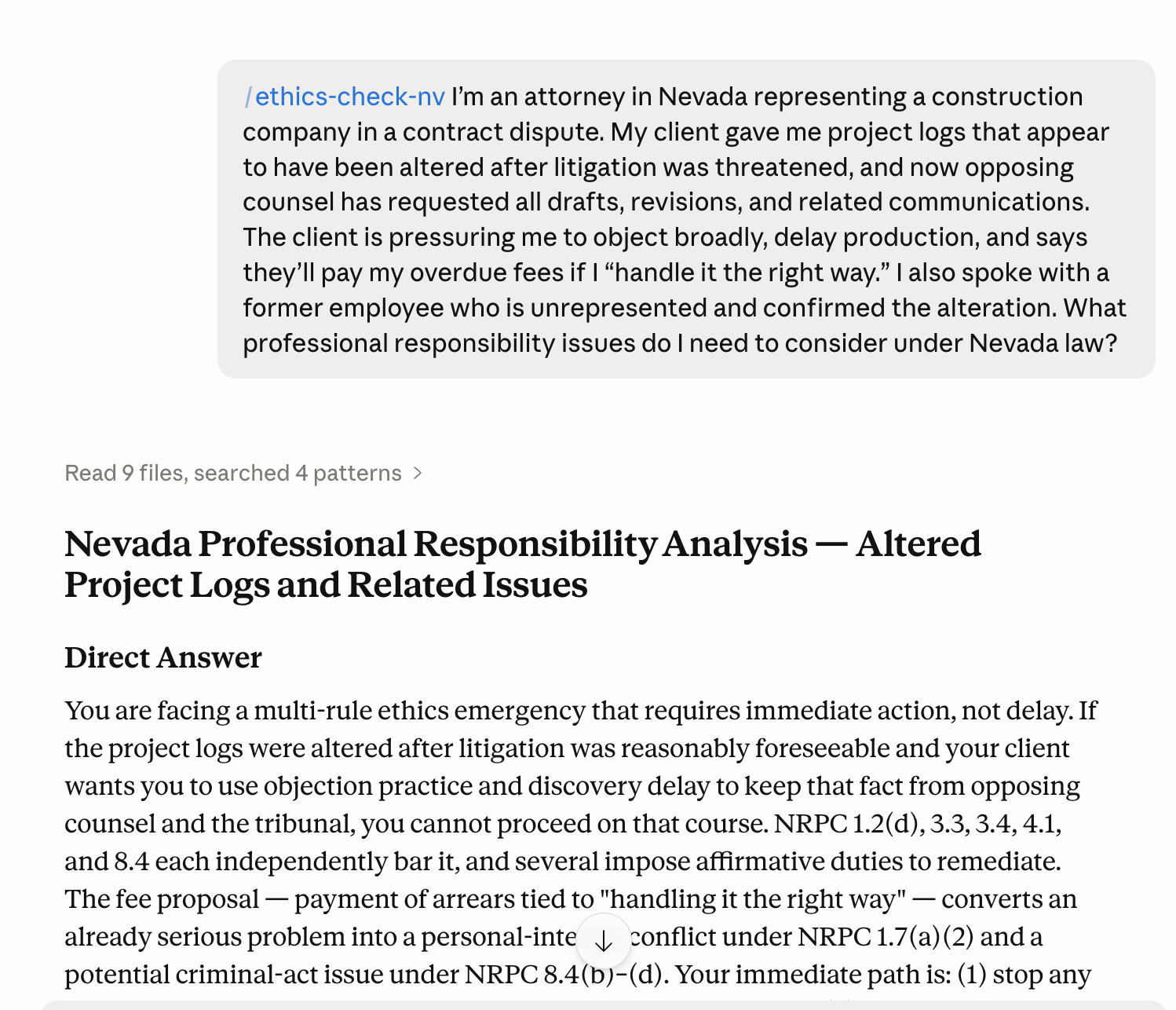
This is a Claude based research tool to help triage Nevada professional responsibility questions against the Nevada Rules of Professional Conduct (NRPC), Nevada Supreme Court Rules (SCR Part III), the Disciplinary and Standing Committee Rules of Procedure, and Nevada Formal Ethics Opinions.
Given the amount of time that can be saved by using AI, it is unethical to build a client for hours for a memo that now can be written in one hour when using the proper tools. Attorneys have a duty of competence, and that means using the best tools available to advocate for their clients and understanding them.
Attorneys must make an effort to understand how the LLM models are created. We must understand the prompts (system prompts and user prompts) that are used, the context, and how to verify the output.
“The practice of law, at its best, is the disciplined application of legal craft to the concrete circumstances of a real person, family, or business, with the goal of giving them more control over their lives and less exposure to avoidable risk. Accuracy is non-negotiable: every analysis is anchored to primary authority, every assumption is surfaced, and uncertainty is named rather than papered over. Structure serves clarity, because issue-by-issue reasoning and explicit comparison of alternatives are how complex problems become tractable for clients and defensible in court. And the client’s priorities — efficiency, court-avoidance, predictable cost, and durable solutions that hold up when life shifts — define what success actually looks like. The measure of the work is not legal performance but legal value: whether it serves the client’s actual life, quietly and reliably, long after the engagement ends.” - Claude Opus 4.7 (in response to prompt requesting a description of Joel Kaufmann’s legal philosophy)